10th Review Meeting of the IAEA Convention on Nuclear Safety
From 13 to 24 April 2026, ASNR participated in the Review Meeting of the Convention on Nuclear Safety, which brought together 87 Contracting Parties in Vienna (Austria), at the headquarters of the IAEA. The purpose of this Convention is to ensure the safety of nuclear power plants and to implement a triennial peer review process, during which each country is required to report on the commitments it has undertaken under the Convention.
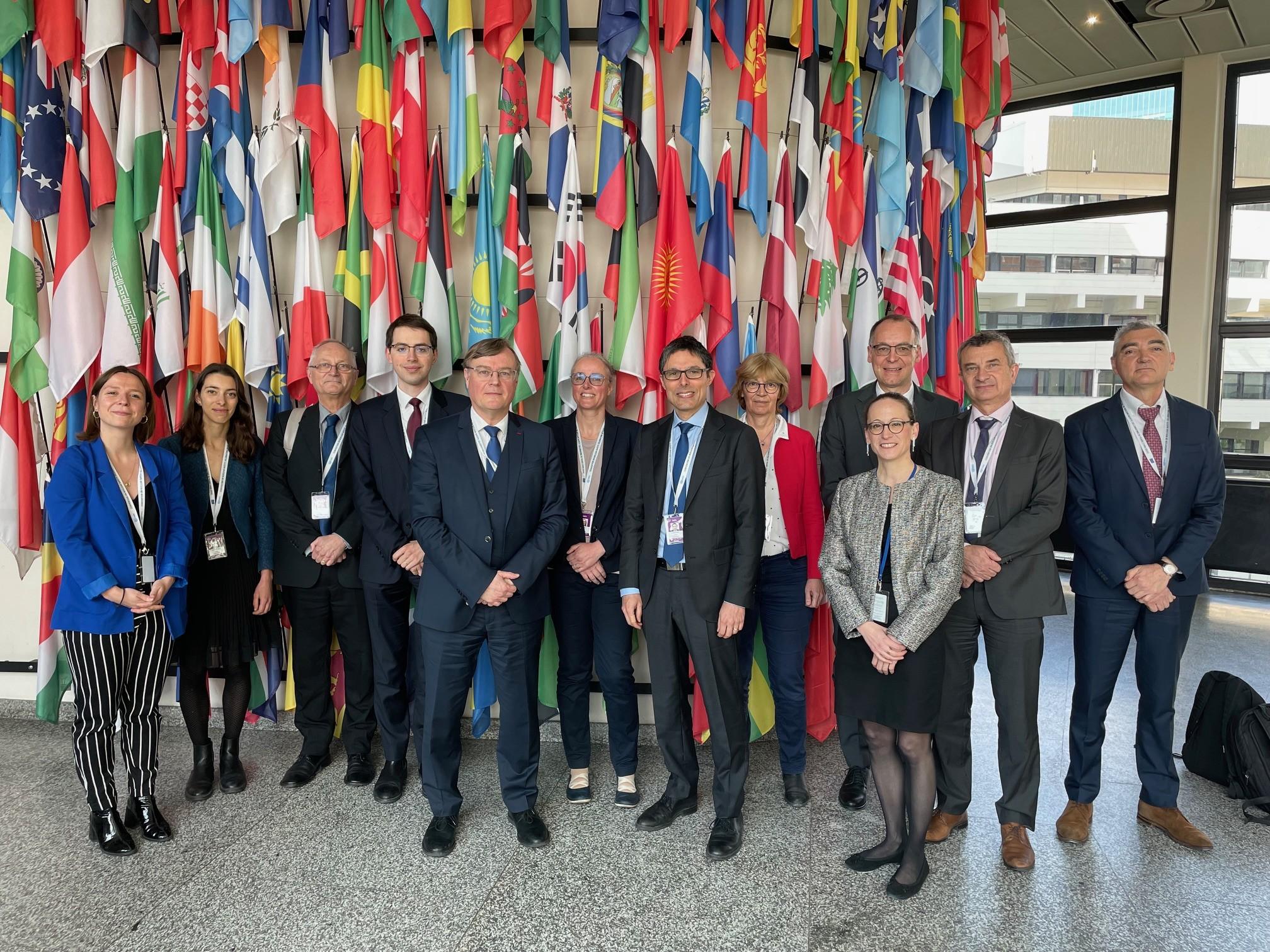
The ASNR delegation at the 10th Review Meeting of the IAEA Convention on Nuclear Safety.
From left to right: Fanny Pigot, Albane Fontaine, Thierry Ethvignot, Paul Durliat, Pierre-Marie Abadie, Marie Dion, Julien Collet, Sylvie Cadet-Mercier, Olivier Dubois, Delphine Hournau-Pouëzat (Ambassador, Permanent Representative of France to the United Nations Office and other International Organizations in Vienna), Luc Chanial, Thierry Granier.
Throughout the exercise, ASNR was mobilised at several levels. It first prepared and submitted the national report presenting the actions taken by France to meet its commitments, including the organisation of nuclear safety and the measures put in place to ensure the safety of nuclear reactors from design through operation, among others.
> Download France's report
A team of focal points, mainly composed of staff from ASNR’s regional divisions, then analysed numerous foreign national reports, drafting questions and comments addressed to more than 80 countries. In turn, France received more than 240 questions from its peers, to which responses were prepared by the relevant ASNR departments and by French nuclear operators.
The first week of the Review Meeting was mainly devoted to the presentation of national reports, organised by groups of countries across seven parallel sessions. ASNR’s team of focal points followed the discussions and intervened in several groups. In addition, Olivier Dubois, Commissioner of ASNR, chaired a group bringing together the following countries: Ukraine, Canada, Romania, Armenia, Slovenia, Zimbabwe, Ghana, North Macedonia, Italy, Poland, Iceland, Montenegro, Nigeria and Lithuania.
In parallel, a working group in which ASNR took part met to identify areas for improvement in the Convention’s processes, in particular in order to take account of the rapid evolution of nuclear reactor applications and technologies. At the proposal of France, Japan and Canada, it was suggested that in-depth discussions be organised on the types of nuclear reactors to be considered in the definition of the term “nuclear installation” in the context of the Convention on Nuclear Safety (CNS). This issue is expected to be included on the agenda of the forthcoming organisational meeting, which will examine how it could be addressed during the 11th review cycle.
Finally, the last part of the second week was devoted to validating, by consensus, the summary report of the Review Meeting. The draft report, proposed by the President of the Convention, was the subject of lively yet constructive discussions. A significant share of the exchanges focused on the ongoing situation in Ukraine, reflecting opposing positions among States. Nevertheless, the collective efforts made it possible to reach consensus on a technical and substantial summary report.
ASNR’s participation was noted and commended by peers and officers of the Review Meeting. This involvement enabled ASNR to promote its activities and positions and further strengthened its status as a leading nuclear safety authority. In addition, several bilateral meetings were held on the sidelines of the meeting. The President of ASNR met with his American (NRC), Chinese (NNSA) and Ukrainian (SNIRU) counterparts, as well as with Delphine Hournau-Pouëzat (Ambassador, Permanent Representative of France to the United Nations Office and other International Organizations in Vienna) and Karine Herviou (Deputy Director General in charge of nuclear safety and security at the IAEA). Lastly, exchanges also took place with the UK Department for Energy Security and Net Zero (DESNZ) and with the Singaporean nuclear safety authority (NEA).
France’s report: one good practice and nine areas of good performance
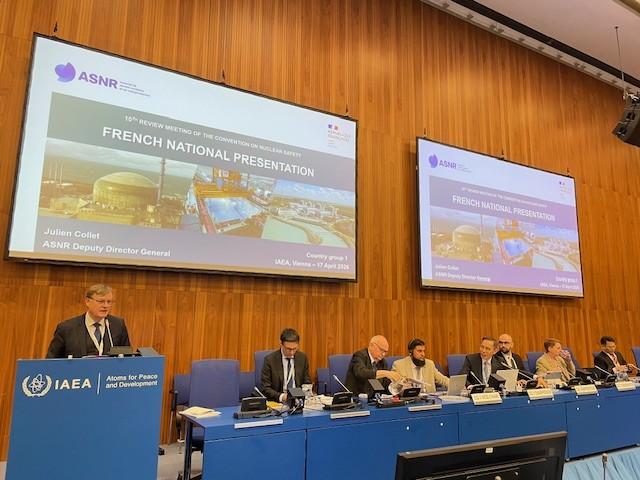
Pierre‑Marie Abadie during the presentation of France’s national report.
The presentation of France’s report took place on Friday, 17 April 2026.
Julien Collet, Deputy Director General, presented the overall framework for nuclear reactor safety in France, recent developments, progress achieved in the field of safety, and key issues. Bernard Le Guen, Executive Director for International Affairs at EDF, provided the operator’s perspective. In his concluding remarks, the President of ASNR, Pierre Marie Abadie, recalled the fundamental principles of nuclear safety (transparency, independence of the authority, science based decision making) and conveyed the message of the decisive contribution of safety to efficiency and industrial performance in the context of new nuclear projects.
Discussions with the audience covered a wide range of topics, including safety improvements implemented for reactors as part of periodic safety reviews, the reform of nuclear safety oversight in France, and issues related to skills and competencies.
At the end of these exchanges, the other countries in the group attributed one good practice to France: the French nuclear industry’s action plan aimed at anticipating skills and human resource needs in the nuclear sector.
Nine “areas of good performance” were also identified, including in particular:
- the use of feedback from EPR experience in the design of EPR2
- the promotion of new reactors, notably through the pre-authorisation framework for innovative small reactors
- adaptation to the challenges of climate change, including the ADAPT project
- the improvement of the robustness of facilities against external hazards (such as risks related to aircraft)
- the efforts deployed in the context of periodic safety reviews, in particular those aimed at aligning, as far as possible, the safety levels of second-generation reactors with those of new-generation reactors (Gen 3+)
- the use of artificial intelligence for the review of inspection follow‑up letters
- the commitment to OSART missions.
In addition, two key issues were identified:
- the simultaneous review of several construction licence applications (the EPR2 projects at the Penly and Gravelines sites, and the first licence application for an SMR)
- ASNR’s position on the prospects for operation of the existing nuclear fleet beyond 60 years.