PUMA: An international collaboration to advance knowledge of nuclear criticality
In 2026, ASNR participated in a series of criticality experiments conducted at the National Criticality Experiments Research Center in the United States as part of the PUMA project (Plutonium Uranium Mixed Spectrum Applications). Building on more than a decade of Franco-American scientific cooperation, this campaign aims to advance the knowledge needed to assess the safety of facilities that use fissile materials containing plutonium.
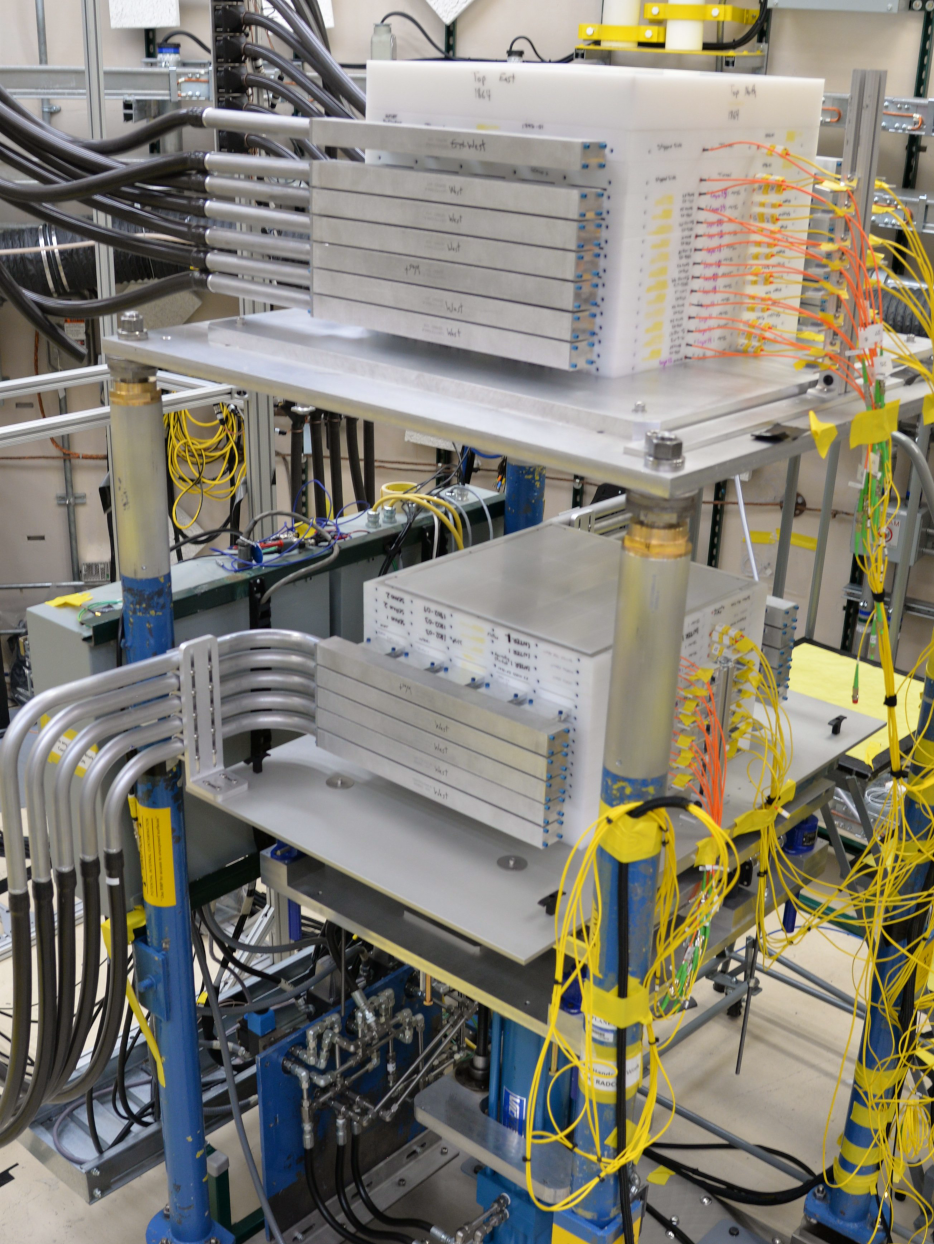
A stack of fuel plates made of metallic uranium and plutonium, separated by polyethylene and aluminum plates, in proportions that allow criticality to be achieved.
Managing the risk of criticality is a fundamental aspect of nuclear safety. It involves preventing the accidental initiation of a nuclear chain reaction during the handling, transport, processing, or storage of fissile materials. To assess this risk, experts rely on computational tools whose reliability depends, in particular, on experimental reference data.
With this in mind, ASNR has been collaborating for more than ten years with the U.S. Nuclear Criticality Safety Program. This cooperation recently led to the design and subsequent implementation of the PUMA program, which aims to deepen understanding of the neutron behavior of plutonium isotopes present in MOX fuel in order to improve the computational methods used in criticality studies.
The experimental setups were designed to be representative of situations encountered in nuclear fuel cycle facilities, laboratories, storage sites, or during the transport of fissile materials. The data acquired will help improve the calculation methods used in safety demonstrations and reduce certain uncertainties associated with the assessment of criticality risk.
This campaign also marks the first series of experiments involving plutonium designed by ASNR teams since the 2013 shutdown of the French criticality facilities at CEA Valduc. It demonstrates ASNR's capacity to maintain and develop high-level capabilities in a particularly demanding field of expertise.
The PUMA campaign is the result of close collaboration between ASNR teams and the leading U.S. research laboratories—Los Alamos National Laboratory and Lawrence Livermore National Laboratory. Together, the partners have defined experimental configurations that address knowledge gaps identified by ASNR and widely shared by the international nuclear criticality community.
This cooperation is particularly important given that the infrastructure needed to conduct this type of critical experiment with plutonium is no longer available in France or Europe. Access to these experimental facilities and the sharing of related expertise are therefore essential for continuing to acquire the data necessary to validate computational tools and maintain a high level of expertise in nuclear safety.
Beyond their scientific contributions, the PUMA experiments demonstrate ASNR's ability to design and manage complex experimental programs that draw on expertise in neutron science, engineering, instrumentation, and safety analysis. Maintaining this knowledge base is a strategic priority to ensure independent assessment regarding facilities that use fissile materials at various stages of the fuel cycle, including downstream processes.
Initial results confirm the value of the experiments conducted, and the quality of the data acquired. Their exploitation will continue in the coming months to derive all possible scientific insights. This work will also contribute to the preparation of a new experimental campaign, called PLUME, which will extend the research underway on the behavior of plutonium-containing fuels.
Through its participation in the PUMA program, ASNR contributes to the development of the scientific knowledge necessary for nuclear safety while strengthening its internationally recognized engineering capabilities and expertise, which are essential for addressing current and future challenges in the nuclear fuel cycle.