ASNR 2026 New Year's address: In a high-stakes environment, ASNR is ready to take on the challenges ahead
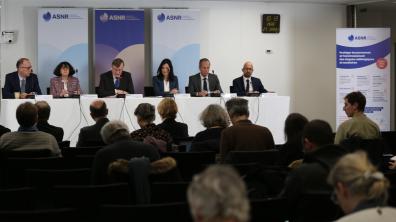
On 27 January 2026, ASNR presented its annual address to the press. Pierre-Marie Abadie, President, highlighted the Authority's successful establishment in its national and international environment. On its first anniversary, ASNR is ready to take on challenges in all its areas of activity: research, expertise, instruction and control. The President also outlined the challenges identified by ASNR and the major issues it will address in 2026. The College then answered questions from the journalists present.
In the field of nuclear safety
The renewed interest in nuclear power presents ASNR with challenges that it is committed to addressing. In this context, safety, whose primary purpose is to protect people and the environment, also becomes a performance factor for industrial projects and must be considered at all stages, from design to implementation.
ASNR is reviewing applications relating to the EPR2 industrial programme in accordance with the planned schedule
- Penly
ASNR has completed the safety assessment phase of the creation authorisation application to build two EPR2 reactors at the Penly site, in accordance with its established schedule.
ASNR's expert opinions have been published.
Consulted on three topics of particular importance for safety, the Advisory Committee for Nuclear Reactors concluded that, at this stage of the project and in view of the safety objectives assigned to EPR2 reactors, the design of the safety systems appears appropriate, the approaches, assumptions and design provisions adopted for the risks of damage examined are generally suitable, and the results of the studies of accidents without core meltdown are acceptable. The Advisory Committee made two recommendations and a series of observations on specific technical points.
ASNR will take the conclusions of these expert assessments into account in its review of the creation application submitted by EDF, which will lead to an opinion to be submitted to the Government by the end of 2026.
In addition to the technical review of the application conducted by ASNR, the review procedure conducted by the Minister responsible for nuclear safety is continuing, with a public inquiry being held from 22 January to 4 March 2026.
- Gravelines
For the project to build two EPR2 reactors at the Gravelines site, where the soil is relatively loose at great depths, ASNR examined EDF's initial proposals for the foundation design and expressed its areas of concern. EDF will provide new information and possibly modifications to the foundation design in March 2026. ASNR will continue its technical dialogue with EDF and issue an initial position in the fall of 2026. Beyond the specificities of Gravelines, ASNR wants to draw lessons for other potential sites for future EPR2 reactors.
ASNR anticipates safety issues that could arise from operating reactors beyond 60 years of service
The French nuclear power reactors were commissioned according to a tight schedule, mainly in the 1980s. This situation could lead to their permanent decommissioning over a relatively short period of time. The possibilities for continuing to operate EDF's current reactors must be anticipated so that, if this course of action is taken, there will be no compromise in terms of safety. Since 2023, ASNR has been engaged in technical discussions with EDF to obtain the information needed to develop, from a nuclear safety perspective, projections for the operating life of reactors to be used by energy policy makers. The approach consists of identifying and examining generic factors that could limit the operating life to 60 years or beyond, such as the ageing of concrete and certain metal components that are difficult or impossible to replace. Potential obstacles to long-term continued operation and possible levers for overcoming them will thus be examined.
After a period of dialogue with stakeholders, followed by a review by an Advisory Committee at the end of June, ASNR will issue its opinion in November 2026.
Challenges facing fuel processing plants
The long-term operation of a large nuclear power fleet requires an operational network of front-end (fuel production) and back-end (reprocessing) fuel cycle facilities. ASNR has repeatedly highlighted the importance of ensuring the short-, medium- and long-term consistency of this system, particularly to avoid congestion in spent fuel storage capacity.
Today, as part of the government's long-term national plan to continue reprocessing spent fuel, industrial projects to replace several plants are underway. The construction and commissioning schedule for these new facilities spans several decades. ASNR is therefore preparing to continue addressing the safety and radiation protection issues associated with the long-term operation of existing plants, while conducting assessments and providing guidance for future facilities, starting with the selection of initial design options for long-term safety and radiation protection.
To meet this challenge, ASNR is working to organise future instructions, coordinating regulatory deadlines with project milestones. In particular, in 2026, ASNR expects to receive three safety options dossiers, prior to creation authorisation applications, for projects for a spent fuel storage pool, a plutonium storage and a new MOX fuel production plant.
In the field of medical exposure and radiation protection
In 2025, the state of radiation protection in the medical field remains at a satisfactory level, relatively stable from one year to the next.
The year 2025 was nonetheless marked by several notable events in conventional radiology involving patient cohorts. Analysis of these events revealed multifactorial causes, but also common causes that point to a lack of radiation protection culture, particularly regarding the implementation of the principle of dose optimisation.
ASNR reiterates that the main guarantee of a high level of radiation protection lies in a strong radiation protection culture, supported by trained professionals with the appropriate resources and tools.
Press contact
+33 01 58 35 70 33 - presse@asnr.fr
Download